The European textile industry is undergoing a highly delicate transition: on this side, growing regulatory pressure; on the other, an economic situation weighing heavily on small and medium-sized enterprises in the fashion supply chain. In between, a need to profoundly rethink the dynamics of the sector, starting with the way products are designed, tracked and recycled.
AISEC – Italian Association for the Development of the Circular Economy – is working on this challenge, both industrial and cultural: an organisation that <<was born in 2015 from an idea that developed during an experience in France on the circular economy. I realised that Italy, despite having the perfect industrial substrate to implement this economic model, did not yet have an independent association dedicated full time to its dissemination,>> says founder and president Eleonora Rizzuto. <<Shortly afterwards, thanks to a meeting with Enrico Giovannini, economist and former minister, then scientific director of ASviS (Italian Alliance for Sustainable Development), we also joined the national coordination of Goal 12 of the 2030 Agenda.>>

AISEC activities for the circular economy
Non-partisan and non-profit, the association receives no public funding, relying solely on membership fees and the projects it develops, a choice that guarantees its autonomy and consistency. It has four operational pillars: textiles, new technologies and AI, food, and education and new generations. <<On this fourth point, we have worked with ASviS to introduce the criteria of social and environmental impact on new generations into the Italian regulatory process for every decree-law. From this, a spin-off project aimed at businesses was also launched to help integrate these principles into their strategies,>> continues Rizzuto, who is also a member of Ecomondo’s CTS, as well as Chief Sustainability & Due Diligence Officer at Bulgari.
AISEC’s activities have evolved over time: <<After the first five years dedicated to training for companies and local administrations, we gradually moved on to structured projects, reinforcing our advocacy and networking activities, from the establishment of the Mediterranean Technology Park for Sustainable Development in Taranto to a number of initiatives dedicated to the textile sector, some of which have an international scope. In France, for example, we collaborate with an organisation active in the Paris district that puts unused fabrics from major brands back on the market.>>
- You may also be interested in: Challenging fast fashion: from “textile graveyards” to the new European regulations
Crisis and regulation: textile sector under pressure
The textile industry in particular will face several developments in 2026: following the introduction of mandatory separate waste collection in 2025, this year will see the organisation of EPR systems and the full entry into force of the Ecodesign Regulation, bringing with it the introduction of the Digital Product Passport and a ban on the destruction of unsold goods. <<The new European regulations come on top of a complex economic phase,>> notes Rizzuto. <<Many companies, especially SMEs, are recording a decline in turnover and adopting a cautious attitude towards the markets. Geopolitical tensions, tariffs and tighter controls on supply chains are leading to a reduction in production chains, with a view to better few, but good.>>
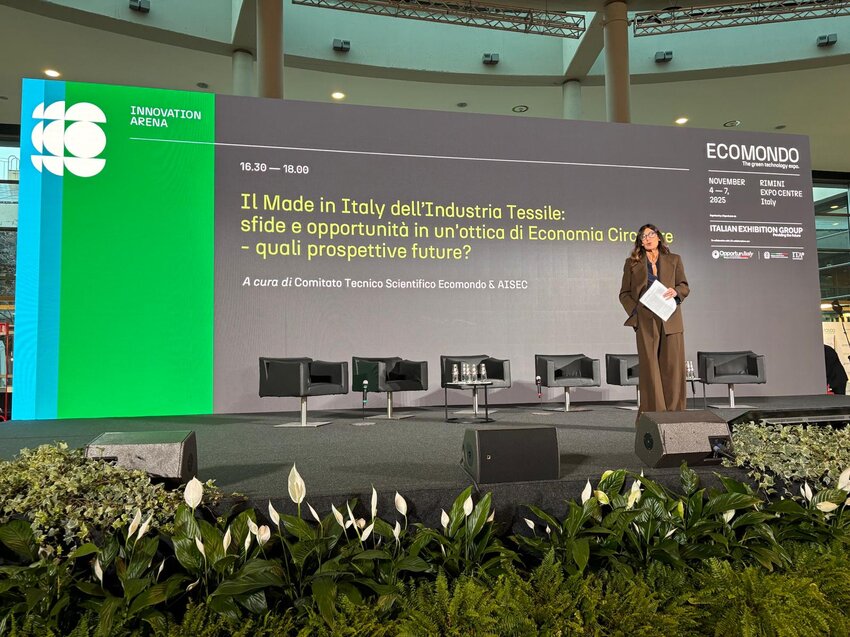
In this context, organising opportunities for discussion and coordination is crucial. <<The 2026 edition of Ecomondo will devote an entire pavilion to textiles for the first time: we want to send a message of resilience and raise the issue with policymakers.>> It will be divided into three sections: <<Ecodesign and production, collection and selection of second-hand goods, and treatment and recycling of secondary raw materials. Our goal is to integrate the system and establish common ground even among competitors, with a strong international focus. For example, one of the events organised by AISEC will be dedicated to EPR and its application in different European countries: producers are calling for regulatory consistency.>>
Ecodesign-oriented planning
What does ecodesign mean in the textile industry?
<<First of all, you need to have a thorough understanding of the raw material. If a fabric contains plastics or chemical derivatives that are difficult to separate, recycling at the end of its life becomes complex or economically unsustainable.>> In addition, it is necessary to consider disassembly: <<A garment often contains other materials, such as metal, plastic, and composite elements: it must be easy to separate the different components. This requires technical expertise, technology, and a clear strategic vision.>>
The Digital Product Passport plays an enabling role in this process: it contains digital information about the product, guarantees traceability and makes the origin of the raw material transparent. <<Today, however, the origin is not always certifiable, especially for certain materials and even precious stones, as mines are often located in countries with uncertified control systems and very precarious working conditions in terms of safety and human rights.>> Rizzuto believes that large buyers will play a decisive role: <<They can guarantee and financially support the traceability of raw materials, thus helping smaller companies that are unable to sustain investments in this area.>>
- You may also be interested in: Europe launches TexMat: financial incentives for those who return used clothing
Prato, a historic model for circularity
When it comes to the recycling of raw materials in Italy, there is the district of Prato, where <<this practice dates back over a hundred years, especially for wool. It is a best-in-class district in terms of technology, know-how and workforce. However, as we are talking about recycling, the origin of the raw material cannot be traced: the garment is not new.>> Here, AISEC also promotes initiatives that combine creativity and recovery. <<We have brought together a number of industrial companies with young creatives under the age of 30. One example is the artist Marianna Faleri, who has used surplus yarns such as linen, silk and wool to create hand-woven works, reviving ancient Calabrian techniques and recounting the history of the region.>>
Recycling initiatives can also be carried out in the field of semi-precious stones, as Rizzuto points out: <<While precious stones such as emeralds, rubies and sapphires are not recycled, or at least only by big names, there are some very interesting projects involving less valuable stones such as jade being carried out by specialist schools, from Tarì in Naples to the goldsmith district of Valenza, developing reuse and training programmes that bring together tradition, innovation and circularity.>>
Article written by Emanuele Bompan and Maria Carla Rota
This blog is a joint project by Ecomondo and Renewable Matter
PUBLICATION
04/03/2026
Other related news
08/09/2022

21/03/2024
Come on, it's just a cigarette stub
24/07/2023
WEEE: a mine of critical raw materials
20/09/2023

30/05/2023

03/04/2025
5 under 30 who have revolutionized the circular economy

21/04/2023
19/05/2023
Ecomondo Mexico and the circular economy in Latin America

31/07/2023
Circular economy in China – past, present, future

14/05/2023
06/11/2023

20/10/2023

07/06/2023
Tides are changing

03/08/2023
10/10/2023

13/05/2023
A new EU industrial plan for the net-zero age