
Not isolated plants, but industrial ecosystems at the core of local networks. This is the direction that the most advanced biogas and biomethane models in Europe are moving towards, putting the principles of the circular economy into practice.
The evolution is evident in various case studies and research projects, also supported at the institutional level. Connecting historic districts and new urban-industrial symbioses is a paradigm in which energy and material flows are integrated and the various local stakeholders form a cohesive system.
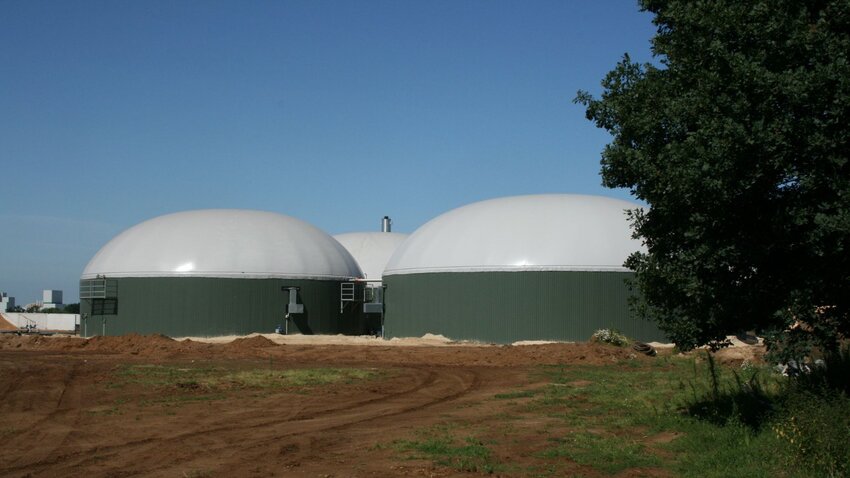
Kalundborg Symbiosis – Denmark
Kalundborg Symbiosis, in Denmark, is mentioned by the European Commission as the world’s first example of industrial symbiosis with a circular approach to production. Established in the early 1970s in the Zealand region, around 100 km from Copenhagen, it brings together 17 public and private entities, including energy companies, pharmaceutical firms and agricultural businesses. Biogas and biomethane underpin a system in which sludge, agricultural by-products and biomass are converted into energy and fertilisers, while the various entities exchange steam, cooling water and waste materials. The fundamental principle is that one company’s waste can become another’s resource. Each year, the system saves the partners and the environment 4 million cubic metres of groundwater through the use of surface water and 586,000 tonnes of CO2, as well as recycling 62,000 tonnes of waste materials.
- You may also be interested in: The European bioenergy landscape: strategic potential and challenges
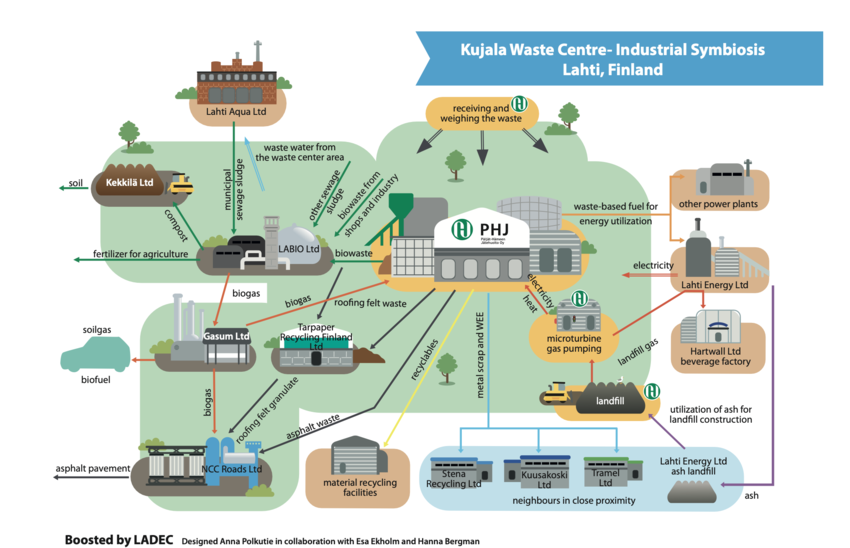
Kujala Waste Treatment Centre, Finland
In the Lahti region of Finland, the Kujala Waste Treatment Centre is one of the most advanced examples of industrial symbiosis applied to bioenergy in an urban setting. Here, waste recovery has achieved very high levels (97%), thanks to an integrated system that combines mechanical sorting, recycling and energy recovery. At the heart of the project is the plant operated by LABIO Ltd, a joint venture between the public waste management operator Päijät-Häme Waste Management and the local water utility. Lahti Aqua: each year it converts approximately 80,000 tonnes of organic waste into biogas (50 GWh/year), fed into the grid, and compost (20,000 tonnes/year), which is reused in agriculture, closing the nutrient cycle. In addition, the methane produced at the landfill site – where only a fraction of the waste is actually disposed of – is recovered and used by local industries, including breweries and food companies, in their production processes. The result is a system in which waste management, energy production and industrial supply chains, all closely interconnected, convert an environmental problem into an economic resource for the local area.
Genesis Biopartner, Romania
In Romania, the case of Genesis Biopartner in Filipestii de Padure, in the district of Prahova, is an example of how the processing of organic waste can be integrated into an agro-industrial supply chain. The company collects biodegradable waste from the catering sector, the agri-food industry and the retail sector and converts it into biogas, renewable energy and fertilisers. While the system was initially based primarily on so-called “energy crops”, today the model has evolved towards the predominant use of waste. This is the context for the new plant currently under development (scheduled for completion in July 2026) in Drăgoești, funded by Romania’s National Recovery and Resilience Plan: the plant will use agricultural effluent and livestock waste to produce biogas and fertilisers, strengthening the integration between agriculture and energy. Each year, Genesis Biopartner processes around 90,000 tonnes of biomass, producing 16 million cubic metres of biogas and 40,000 MWh of electricity (enough for 14,000 households), thereby averting the emission of approximately 67,000 tonnes of CO₂.
- You may also be interested in: Niederbacher (EBA): <<Biomethane as strategic lever for Europe>>
Symbio: EU projects for bio-based industrial symbiosis
Beyond the ecosystems already in operation, work is underway at the European level to promote circular, zero-waste business models that harness local biomass and industrial by-products. This is the case with SYMBIO, a project funded under Horizon EU: the aim is to develop 10 replicable, highly profitable and sustainable models, incorporating big data and artificial intelligence, and to provide regional communities with practical tools to implement them. SYMBIO is structured as a widespread workshop: the methodology is being tested in twelve pilot regions across six countries to ensure adaptability across different local contexts (Lombardy, Piedmont, Veneto, Friuli-Venezia Giulia, Emilia-Romagna, Carinthia, Slovenia, Croatia, Andalusia, Brussels-Capital, Wallonia, Flanders). The project, which will conclude in December 2026, involves an EU contribution of approximately €1.3 million.
GoodByO, a next-generation circular biorefinery
Completing the picture are additional new frontiers in the circular bioeconomy, such as GoodByO: this European project, coordinated by the Italian Institute of Technology, seeks to develop a next-generation biorefinery to transform agri-food waste, biogenic CO₂ and industrial wastewater into high value-added products. In this case, then, biomass is not primarily intended for energy production but becomes first and foremost a basis for the synthesis of molecules for green chemistry, cosmetics, nutraceuticals and agriculture. The project involves the creation of “microbial factories” able to convert waste streams into compounds such as organic acids, proteins and bio-fertilisers.
Article written by Maria Carla Rota
This blog is a joint project by Ecomondo and Renewable Matter
Credits
Photo by Jan Nijman da Pixabay
PUBLICATION
07/04/2026
Other related news
08/09/2022
21/03/2024
Come on, it's just a cigarette stub
24/07/2023
WEEE: a mine of critical raw materials
20/09/2023
30/05/2023

03/04/2025
5 under 30 who have revolutionized the circular economy

21/04/2023
19/05/2023
Ecomondo Mexico and the circular economy in Latin America

31/07/2023
Circular economy in China – past, present, future
14/05/2023
06/11/2023
20/10/2023

07/06/2023
Tides are changing

03/08/2023
10/10/2023
13/05/2023
A new EU industrial plan for the net-zero age