
At the end of 2024, the Financial Times chose the word greenlash to sum up the year that had just ended in its traditional column Year in a word. Regrettably, in 2025, this neologism – a contraction of green backlash – still accurately describes a trend exploited by populist movements on both sides of the Atlantic: the annoyance, or even rejection, of environmental policies and sustainability strategies, frequently perceived by companies as burdensome and by the public as lacking in social awareness.
The European Union now wishes to counter this narrative, which identifies sustainability as an obstacle to growth, by pragmatically resetting its environmental strategies and launching a new slogan: sustainable competitiveness. The new roadmap announced at the beginning of 2025 and christened Competitiveness Compass is based on three pillars: innovation, decarbonisation and supply chain security. It aims to demonstrate that a low-emission economy is not only an essential choice for climate resilience and environmental health, but can also become a driver of development and employment.
What do companies think about it? How are they dealing with the transition in a world of great political and social change?
This was the topic of discussion at Ecomondo during the CEO Summit 2025, which brought together the leaders of some of Italy's most important companies (Versalis, Novamont, Iren, Ferrari, Itelyum, Unidro&Sodai, Gruppo Hera, Gruppo A2A). They met for a debate on the conditions for a just transition in light of the new global economic and geopolitical scenario, during which keywords such as courage, adaptability, cooperation and long-term vision emerged. Above all, a new narrative needs to be constructed that overcomes mistrust and focuses, once again and with greater force, on the positive aspects of the transition.
To delve deeper into these issues, we had a chat on the sidelines of the event with Andrea Alemanno, professor of Business Communication at Bicocca University and head of the Public Affairs and Corporate Reputation Service Line at Ipsos Doxa.
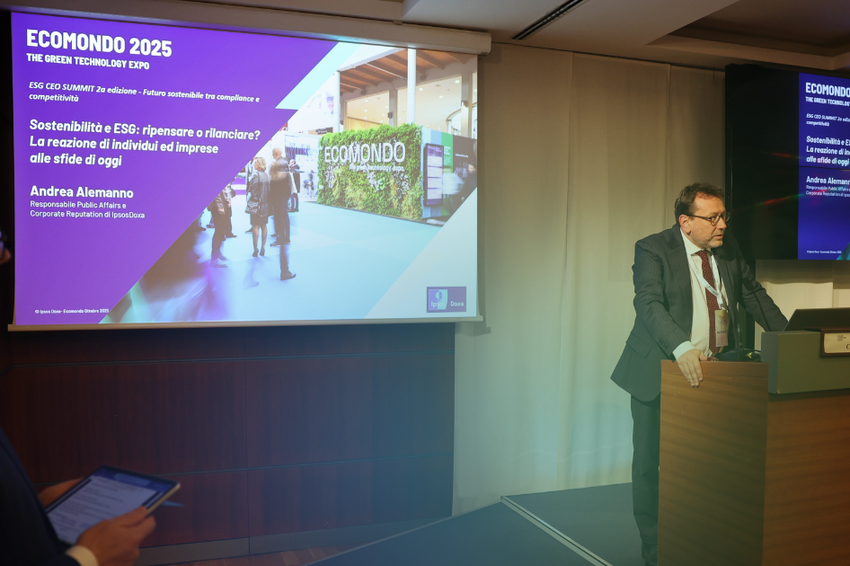
Professor Alemanno, sustainability used to appear to be an accepted concept: how did we end up talking about greenlash today?
<<We often forget that sustainability is a relatively recent issue. Until 2015, it was a specialist topic. Then came the 2030 goals, the Paris COP, and the encyclical Laudato si'. It was also the year of Dieselgate, which, so to speak, snapped us out of our innocence and made us realise that sustainability is a serious issue, and there are no shortcuts. Until then, less than 10% of people really knew what sustainability was.
Then, awareness grew, partly thanks to Fridays for Future, opinion movements and many other initiatives. But today, things are still different. The issue has collided with a changing reality: first with COVID-19, then with the energy crisis, for which renewables have sometimes been unfairly blamed. We are experiencing a moment of strong scepticism, of “greenlash”, in fact. But I see it as a crisis of growth. And it is a crisis stemming from the fact that we have portrayed the transition to sustainability as too “easy”>>.
What were the specific mistakes in this narrative?
<<The term transition, in itself, already gave the idea of a fairly quick and potentially painless change. This was not the case, is not the case, and could not be the case. Former Minister Cingolani was showered with insults when he said, paraphrasing Mao Zedong, that “the ecological transition is not a banquet”. But Cingolani was right: the transition needs to be explained better, in a more rational and serious way, discussing the costs, the necessary infrastructure and the industry's commitments. It must be said that, in spite of everything, the number of people concerned about sustainability is growing slowly but steadily, year after year: today in Italy, we are at 26% of the population.
Of course, it is a long process, with mistakes and inconsistencies. But, as Alex Langer said, we will not get out of it in one fell swoop, quickly: we have to make the effort to convince people, to make them understand that they are in need of a different way of living. One of the mistakes was to consider sustainability as a product, a commodity. Instead, it should have been presented as a process. But from a market perspective, that is an unattractive narrative. The focus was therefore placed on symbolic products such as Tesla, with the result that today, electric cars have become the epitome of all the negative aspects of sustainability for its detractors: an elitist, expensive product for the wealthy.>>
- You may also be interested in: Ecomondo looks to the future of the circular economy
Was it wrong to assess consumer reactions as well?
<<We have failed to understand that consumers have matured over the years: they are aware of sustainability and seek it out, as far as they can and when they don't feel cheated. However, sustainable choices are almost never made out of concern for the future or for ethical reasons. Those who do so for these reasons are in the minority. Whoever chooses a sustainable product or company does so purely for practical reasons, because they think it is a better product, made with more care, more attention, more controls, by a company they can trust. And in this case, they are also willing to pay more. This issue needs to be investigated further and communicated better.>>
Speaking of storytelling, if we had the problem of greenwashing a couple of years ago, are we now moving towards its opposite, green-hushing?
<<That is exactly right. And it could turn out to be worse than greenwashing, which, it must be said, was very often unintentional. A few years ago, it was common for companies to preach one thing and practise another, but today more and more companies are paying attention to sustainability – for legal reasons, or because they believe in it, or because their customers demand it – but they do not preach much. And in doing so, they are not helping to raise awareness of the importance of sustainability. It is therefore essential that companies communicate and do it well, with the courage to walk the long road.>>
And what is the best way to introduce long timeframes into corporate narratives and policies?
<<First and foremost, we need patient and more forward-thinking investors, not least because sustainability is ultimately a way of stabilising finance and reducing risk. But for this, we require reliable measurements. ESG is currently the only reporting system that provides a reliable measurement of what a company does and how it is achieving its objectives. The next step is to have comparable analyses of positive impacts across sectors. Next, we need to narrate the various aspects of sustainability more broadly. Take innovation, for example: sustainability is a world of innovators, and this is a much more appealing topic from a storytelling perspective. You could, for instance, take students on a visit to Ecomondo to see how much innovation there is, how much technology, how much digitalisation. Not to mention how much collaboration: for a sustainable economy is one that competes and collaborates continuously, and this is another positive aspect to communicate.
Back to the topic of ESG, many companies today often express annoyance and impatience with reporting requirements. This is understandable… Unfortunately, in Italy we have already got an endless amount of unnecessary bureaucracy, to which we can now add ESG, that while useful in this case, is still a burden. What's more, we often lack adequate technological systems, which do not make the task any easier. Another problem for companies is the endless inspections. The point is that we should also allow for the possibility of making mistakes; development cannot always be linear. Perhaps a company has had a particularly difficult year and cannot be allowed to fail just because it has not achieved its ESG targets. The opportunity to recover should be given, for example, over three years. This is what happens with debts, which are restructured to allow them to be repaid.>>
- You may also be interested in: The 10 most innovative technologies according to Ecomondo
This is somewhat the idea behind the European Union’s Competitiveness Compass. How do you feel about it?
<<The major media and political risk is that the Competitiveness Compass will be perceived as a step backwards. The EU is not stating, ‘All right, we have gone too far, let's take a step back, do what you want for a few more years.’ The correct interpretation is, ‘We are giving you a little more time to do your homework properly, because otherwise we will all fail.’ I am simplifying, but there is a strong risk that this roadmap will be seen as a retraction of the Green Deal, which would be a real shame.
Another point is that one of the mistakes of the Green Deal was to go into too much technical detail about how to solve problems, when it should have remained at the level of objectives. By going into technical detail in a world that, as I said before, is highly innovative, you risk killing innovation. The objectives must be clear, without going into such specific detail about how to achieve them. For example, for the automotive industry, it would make sense to set a maximum level of CO2 emissions from motor vehicles by a certain date, in 10 or 15 years' time: then how the market gets there is their own problem, we cannot know what will be devised by then. If, on the other hand, the transformation of an industrial sector is imposed, there is a risk that it will not be able to do so.>>
In conclusion, we must not rush into things and we should think positively.
<<Think positively and don't get discouraged. It's time to become a little more serious and a little more visionary, in the sense of having a long-term view of the situation. Rushing has always been a bad idea. Urgency is fine, but if your house is on fire, and you rush around frantically, you risk fuelling the fire. So, even if your house is on fire, you need to take sensible action to put it out.>>
Article written by Giorgia Marino
This blog is a joint project by Ecomondo and Renewable Matter
PUBLICATION
26/11/2025
Other related news
08/09/2022

21/03/2024
Come on, it's just a cigarette stub
24/07/2023
WEEE: a mine of critical raw materials
20/09/2023
30/05/2023

03/04/2025
5 under 30 who have revolutionized the circular economy
21/04/2023
19/05/2023
Ecomondo Mexico and the circular economy in Latin America

31/07/2023
Circular economy in China – past, present, future
14/05/2023
06/11/2023
20/10/2023

07/06/2023
Tides are changing

03/08/2023
10/10/2023
13/05/2023
A new EU industrial plan for the net-zero age