
Often considered a fleeting, subjective and unmeasurable emotion, happiness is actually a true state of being that must be sought with commitment and awareness, so much so that the American Constitution, one of the founding texts of Western civilisation, includes the pursuit of it among its principles. It is not something that happens by chance, then, but a path that requires individual responsibility and favourable collective conditions.
And science can investigate it to better understand how to build happiness for oneself, including in the workplace and in society. This has been the focus of Sandro Formica, professor of “Positive Organisations” at Florida International University and founder, together with the colleagues Elga Corricelli and Elisabetta Dallavalle, of the Osservatorio BenEssere Felicità (Well-being and Happiness Observatory), which for six years has been collecting data from Italian workers through the Barometro della Felicità (Happiness Barometer). <<First of all, a clarification: the distinction between wellbeing and happiness is more apparent than real; the two terms are essentially used as synonyms. Aside from a nuance concerning physical wellbeing, perceived as a more ‘tangible’ dimension, overall the two concepts coincide, which is why we like to talk about happiness.>>
From a scientific point of view, international research agrees on three fundamental components: joy, that is, the emotional dimension; intentionality, or the conscious commitment to pursue it; meaning, the sense we attribute to the actions we perform. <<Without this last element, happiness remains incomplete. A momentary pleasure can generate emotion, but it does not build a true state of lasting wellbeing,>> specifies Sandro Formica.

How to apply the science of happiness in the workplace
Is it possible to be happy at work or, more generally, in society?
Yes, if the science of happiness is extended from individuals to teams and organisations through consistent systems, processes and practices. <<During a research period at Claremont University, one of the world's leading centres for Positive Organisational Psychology, I collected and categorised hundreds of studies on so-called positive organisational interventions: tested in companies of different sizes and sectors, with measurable evidence of results.>>
Drawing on the idea of the DSM, the manual for diagnosing mental disorders, Formica's idea was to construct a “diagnostic manual of corporate pathologies”: chronic stress, lack of recognition, hidden conflicts, and misalignment between personal values and organisational goals. These are widespread and, above all, measurable problems. And what is measurable can be addressed.
In this regard, one of the most effective interventions, for example, is <<Job crafting, or the possibility of shaping one's work based on their strengths, values and intentions. It is not a question of overturning roles and tasks, but rather of considering work as an extension of being, not just of doing. When this connection is made, motivation, involvement and performance increase.>>
Another strategy is mapping out needs: <<Companies know little or nothing about the real needs of the people who work for them. Yet science is clear: if a fundamental need is not met, performance drops.>> In Italy, according to research by Sandro Formica, <<the most widespread need is recognition. In the absence of positive feedback on their work, employees feel they are in a hostile environment and enter survival mode, focusing on protecting their position and ceasing to express their potential.>>
Mapping needs, measuring the level of satisfaction and developing targeted improvement actions are some of the keys to organisational happiness. <<And the results are verifiable: as the satisfaction of needs increases, so do the main performance indicators.>>
- You may also be interested in: Companies: how to communicate the transition in the greenlash era?
Happiness, society, environment: a collective challenge
While the path is complex for businesses, the challenge of building a happy society is even greater. The United Nations World Happiness Report, released annually on 20 March, evaluates over 150 countries based on various indicators, including the perception of living in a society that supports the achievement of individual goals. <<This is where Italy shows one of its greatest weaknesses. Italians, generally perceived as creative and capable, do not feel supported by the system in achieving their goals. A paradox that penalises collective wellbeing. Applying the science of happiness to society also means, in this case, mapping needs and expectations and building contexts that allow people to flourish, rather than merely survive.>>
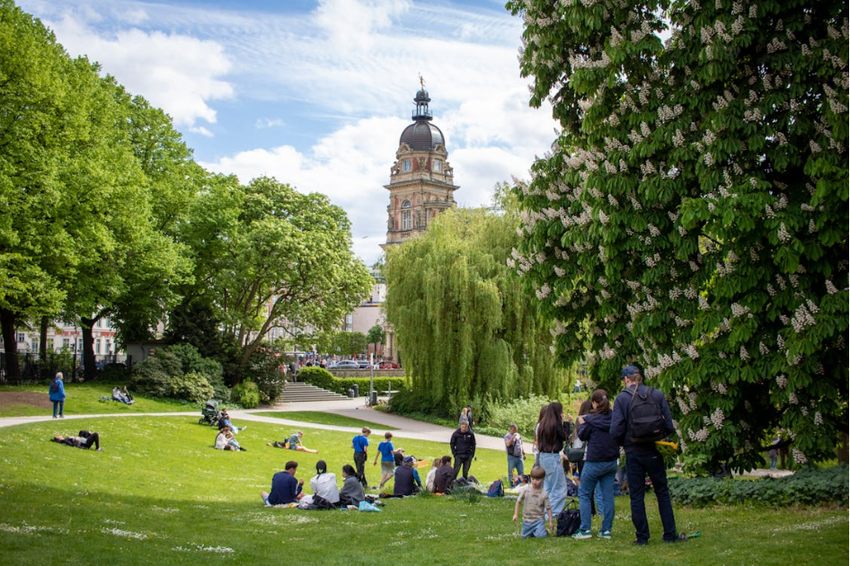
In recent years, an edition of the World Happiness Report has also devoted a specific focus to nature, highlighting the strong connection between happiness, the environment and social relationships. <<By measuring people’s levels of happiness in different contexts, the results are clear: contact with nature increases wellbeing, and does so even more when experienced together with other people.>>
This data also has practical implications for businesses. <<There are case studies in which the design of workspaces, surrounded by greenery and conceived to encourage movement and interaction, has yielded significant benefits in terms of health and productivity. Natural light in the office, views of an internal garden, and having to cross an open space to reach different buildings within a company are factors that have a profound effect on human functioning.>> Health studies also demonstrate this: people exposed to natural light and greenery show better health outcomes than those who live in closed, artificial environments. Happiness, therefore, cannot be separated from the environment in which we live and work.
Towards “sustainable happiness”
In addition to environmental sustainability, therefore, “human sustainability” is also essential: a concept that relates to the ability to create work and life systems that are sustainable over time. Leadership and management geared exclusively towards the short term lead to burnout, a syndrome resulting from chronic work-related stress recognised by the WHO. <<It is not a functional strategy; it is like driving a car at maximum revs all the time.>> Not surprisingly, recent years have seen phenomena such as the Great Resignation, mass voluntary resignations during the pandemic, and Quiet Quitting, an attitude consisting of doing only what is formally required by the company, without additional involvement, redefining the boundaries between professional and private life. <<Often superficially interpreted as apathy or lack of commitment, these phenomena are actually a systemic response to work environments perceived as unsustainable, meaningless and unable to recognise people's needs. It is not a rejection of work itself, but of organisational models that consume energy without generating wellbeing.>>
In short, the way people want to experience work has changed: organisations that can interpret this change will not only survive but be more resilient and attractive in the long term. <<Sustainable happiness implies a change of perspective: to stop seeing people as productive cogs and start seeing them as human beings with values, needs and aspirations. When this happens, people not only feel better, but they flourish.>> And it is precisely this flourishing – individual, professional and social – that plays a fundamental role in the future.
Article written by Maria Carla Rota
This blog is a joint project by Ecomondo and Renewable Matter
PUBLICATION
29/01/2026
Other related news

08/09/2022

21/03/2024
Come on, it's just a cigarette stub
24/07/2023
WEEE: a mine of critical raw materials

20/09/2023

30/05/2023
03/04/2025
5 under 30 who have revolutionized the circular economy

21/04/2023

19/05/2023
Ecomondo Mexico and the circular economy in Latin America
31/07/2023
Circular economy in China – past, present, future
14/05/2023
06/11/2023
20/10/2023

07/06/2023
Tides are changing

03/08/2023

10/10/2023

13/05/2023
A new EU industrial plan for the net-zero age