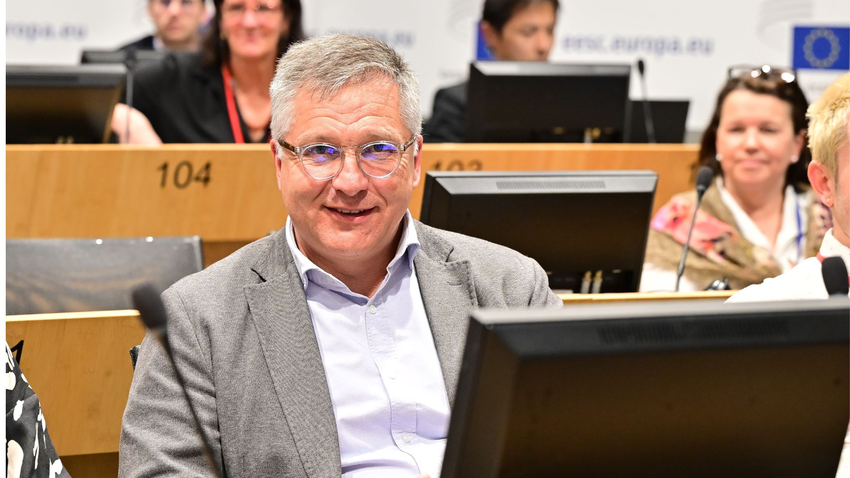
Stoyan Tchoukanov is President of the NAT Section (Agriculture, Rural Development and the Environment) at the European Economic and Social Committee (EESC). Bulgarian beef farmer and engineer by training, president of the Beef Breeders Association of Bulgaria, Tchoukanov offers a rare combination of policy experience and frontline agricultural practice.
The EESC’s NAT section produced the first official European institutional paper on regenerative agriculture and is currently finalising an opinion on the EU Bioeconomy Strategy. We met him at the European Circular Economy Stakeholder Platform (ECESP) conference in Brussels, held on 22–23 April 2026.
The EU bioeconomy generates over €2 trillion in annual turnover and employs 17 million people, yet its potential as a driver of circularity, strategic autonomy and rural resilience remains largely untapped.
Enrico Letta’s ECESP keynote speech called for deepening the single market. What does this mean specifically for the bioeconomy?
I strongly agree with Letta’s analysis. We need to move as quickly as possible towards one Europe, one market. For the bioeconomy, this is critical, as it is still largely linear. We need to scale it up as part of the circular economy. The idea from the EU Bioeconomy Strategy to organise local biomass hubs goes precisely in this direction: assembling biomass at the regional level to achieve better use and better profitability.
But deepening the single market also means harmonising legislation. The definition of waste in one country is not the same in another — if somebody’s trash is somebody’s treasure, we need to synchronise these definitions. Many young European entrepreneurs end up leaving because they enter an endless process of approvals.
They get stuck in the valley of death between demonstration and industrial scale-up. At the end of the day, you must be profitable. And Letta is right to focus on the three sectors still left behind: finance, energy and connectivity.
- You may also be interested in: Circularity, autonomy and security: Europe can no longer wait
Which bioeconomy sector is the most advanced and could inspire others?
In northern Europe, forestry is very advanced – when you see buildings many storeys high built entirely from wood, you realise the sky’s the limit. But forestry is, in a way, a no-brainer. I think the greater untapped possibilities lie in agriculture.
Millions of tonnes of agricultural biomass remain unused. We should not consider it waste: it’s a co-product, not a by-product. There is a slight but important difference. Going deeper into the structure of biomass – i.e., disassembling components and reassembling them – gives us opportunities for materials, packaging, chemicals.
And crucially, the cascading principle: respecting food and feed priorities, but extracting maximum value at each stage before using the residual for energy. We can do much more before reaching incineration.
Europe’s average farm is 17.6 hectares. Is this small scale a barrier to scaling up the bioeconomy?
I don’t think it’s a disadvantage. We need more investment in logistics; on how to assemble co-products from, say, the wine industry. Smaller-scale sourcing diversifies supply and makes the system more resilient. And focusing on the bioeconomy means focusing on self-sufficiency.
This is strategic. Relying on somebody else’s huge biofuel production just replaces one dependency with another. We are currently working on an EESC opinion on non-chemically modified, nature-based biodegradable materials.
Not bio-plastics: a different category entirely, but they can replace fossil-based plastics, and for many characteristics they are better. They’re biodegradable, for example, so you eliminate the problem of combining materials that cannot be economically separated. And you’re using biomass produced in Europe, without competing with primary agricultural production – we’re talking about the 27% that we currently throw back on the field or burn.
The biomass hubs concept is central to the strategy. How would they work in practice?
Instead of each farmer burning something somewhere, a hub can collect, aggregate and process the material, thus giving farmers an additional income stream.
As for the way they’re structured, I think we should leave room for private initiatives. I come from the private sector, and top-down guidelines are not always welcome.
What we call for is better regulation, not more regulation. And we strongly support the Bioeconomy Strategy because it give a green light for European investors.
- You may also be interested in: The European bioenergy landscape: strategic potential and challenges
How can Europe redirect investment towards its own bioeconomy?
Letta is right again: €300 billion of European pension savings are invested yearly in the United States.
That money helps American companies and comes back as foreign investment, in multinationals buying our mineral water producers because they think strategically about water scarcity. We need to rethink this circle.
Why not expect European funds to invest in the European bioeconomy? The European Investment Bank is very engaged – they launched a study on the circular economy investment gap (estimated at about 82 billion) just days ago – and also announced around €3 billion for regenerative agriculture. This is critical because, due to climate change, some agricultural production is becoming uninsurable. Without insurance, there is no credit. So investing in resilience, which means investing in soil health, is no longer optional.
Where does the EU stand on regenerative agriculture?
The EESC was the first official European institution to produce a paper on regenerative agriculture – we voted on it over a year ago. I was invited to present it at the European Parliament’s Agri Committee.
The debate now revolves around the organisation and administration of it. We have a variety of small measures tackling individual components, but regenerative agriculture is context-specific: every region, every farm is different. That makes it difficult to administrate. And without proper administration, you cannot provide public funding with accountability.
The evidence is clear: you can compare fields side by side and see how drought impacts them differently. But the transition takes 5 to 10 years, and the average European farmer is 56. Taking that step is not easy. Still, farmers learn best from other farmers: when you see your neighbour’s field surviving a drought that destroyed yours, you start thinking. And through regenerative practices – cover crops and others – you produce more biomass for the bioeconomy. It’s outcome-based, not prescribed practices. That’s why it’s harder to administer, but also why we need this discussion now.
Article written by Emanuele Bompan
This blog is a joint project by Ecomondo and Renewable Matter
Cover: Stoyan Tchoukanov, photo credit EESC
PUBBLICAZIONE
29/04/2026
Altre news correlate
08/09/2022
Inquinamento da plastica in mare: cause, conseguenze e soluzioni
21/03/2024
Ma dai, è solo un mozzicone
24/07/2023
RAEE: una miniera di materie prime critiche
20/09/2023
La plastica: da problema a risorsa
30/05/2023
Acqua in Europa: come affrontare il cambiamento climatico
03/04/2025
5 under 30 che hanno rivoluzionato l'economia circolare
21/04/2023
La giornata mondiale della terra, vista dal mare
19/05/2023
Ecomondo Mexico ed economia circolare in America Latina

31/07/2023
Economia circolare in Cina. Ieri, oggi e domani
14/05/2023
Sulla strada della sostenibilità: elettrificare il trasporto merci
06/11/2023
Lifegate presenta Water Defenders Alliance, una grande alleanza per difendere le nostre acque
20/10/2023
Legno-arredo, la filiera che ha messo la sostenibilità al centro
07/06/2023
Le maree stanno cambiando
03/08/2023
La filiera del riciclo della carta: eccellenza italiana con margini di miglioramento
10/10/2023
Responsabilità estesa ed ecoinnovazione, la sfida del tessile sostenibile non può attendere
13/05/2023
Europa: arriva il nuovo piano industriale per l’era net-zero