
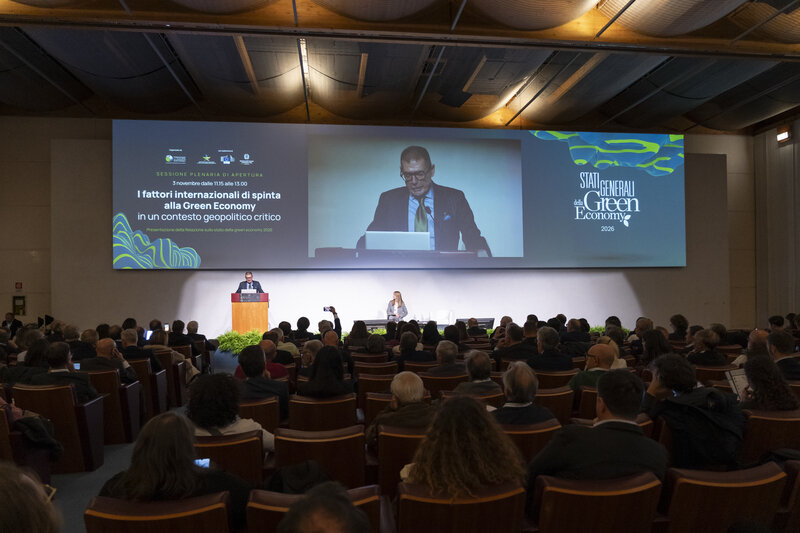
<<In a critical geopolitical context marked by ongoing wars, growing economic difficulties and regressive, denialist policies, there is a very high and widespread risk of being swept along by narrow-minded views, offering illusory solutions that do not solve problems and fail to recognise the real priorities, opportunities and positive drivers. However, the US mid-term elections offer a positive outlook for the green economy: they raise hopes for climate policies and for curbing the excessive influence of fossil fuels.>> Edo Ronchi, president of the Foundation for Sustainable Development, outlined this picture at the 15th edition of the States General of the Green Economy, held in Rimini as part of Ecomondo 2026.
While the first day focused on Italy, the second turned its attention to the wider world, taking in China, the US, the EU and Africa.
- You may also be interested in: Ecomondo beyond the Euro-Mediterranean borders: a 14% increase in international visitors
The transition as a driver of environmental, industrial and economic progress
Against a complex international backdrop, the green transition is increasingly being seen not simply as an environmental issue, but as a strategy to strengthen the competitiveness and resilience of economic systems.
Dependence on fossil fuels and imports of strategic raw materials leaves countries and businesses exposed to price volatility and supply uncertainty. Reducing these vulnerabilities, keeping energy costs down and making more efficient use of resources are all objectives that go hand in hand with climate goals. As Ronchi also pointed out, <<the green transition has become a structural necessity for the socioeconomic stability of many countries and can be a tangible driver of social inclusion and economic growth, as highlighted in the 2025 annual report, ‘Partnership for Action on Green Economy’, produced by five UN agencies>>.
- You may also be interested in: Green Jobs and Skills: Ecomondo connects institutions, businesses and universities
Pichetto Fratin: <<We need to make progress in many areas, from wastewater to separate waste collection>>
<<Ecomondo is a melting pot of knowledge from a national system that has become a major manufacturing hub, but also a major centre for research into the transition, which means secondary raw materials, processing and new job opportunities>>, said Environment Minister Gilberto Pichetto Fratin.
Italy is among the world leaders in plastics recycling and is also performing well in paper recycling. However, the country still faces many challenges, especially in relation to water: <<It is becoming an increasingly valuable resource, so we need to consider: less water from deep aquifers, more water reuse for irrigation – in other words, treated wastewater>>. There are also persistent regional disparities. <<Italy is a long country, and there are regions where separate waste collection rates are lower, resulting in less recycling>>.
<<In the global competition for raw materials, energy and technology, the ability to make the most of resources is a decisive factor in competitiveness>>, said Adolfo Urso, Minister for Enterprise and Made in Italy, in a video message. <<Italy can draw on a strong position of leadership in the circular economy, but reducing our dependence on foreign supplies of materials remains a key challenge. That is why we have made circularity an industrial policy, including in the field of critical raw materials. Ecomondo is where innovation and the environment come together to find solutions that can turn this leadership into a competitive advantage, strengthening Italy’s industrial sovereignty and Europe’s strategic autonomy>>.
The green economy in Italy and around the world: a mixed picture
The picture of Italy that emerges from the 2026 Report on the State of the Green Economy shows both progress and setbacks.
In 2025, greenhouse gas emissions began to rise again, while the rate of renewable energy development (accounting for 19.6% of national energy consumption in 2024, compared with a European average of 25.2%) remains insufficient to meet the 2030 targets (39.4%). Italy remains heavily dependent on imported energy and materials and continues to record high levels of water consumption. By contrast, its strong circular economy performance has been maintained, while registrations of electric and hybrid cars and the value of PDO and PGI products have both increased. Climate adaptation initiatives are multiplying in cities, but, for the first time in ten years, the area of land for organic farming has fallen.
According to the 2025 overview presented by Italy for Climate, the global green economy is also characterised by a series of ups and downs.
Last year, China halted its CO₂ emissions growth, but remains the world's largest emitter, accounting for 27% of the total.
Despite the Trump administration's hostile policies, the US added 40 GW of renewable energy capacity, but also saw CO₂ emissions rise by 1.9% – the largest increase anywhere in the world.
Europe has cut greenhouse gas emissions by 37% since 1990, while GDP has grown by 75% over the same period, but spent 337 billion importing fossil fuels.
Then there is Africa: although the continent is responsible for just 3% of historical CO₂ emissions, it is paying the heaviest price for climate change, with excess mortality projected to reach 50% by 2050.
Eight global forces driving the transition
The 2026 Report on the State of the Green Economy also identifies eight trends accelerating the global green transition, starting with growing awareness of the severity of the climate crisis. According to figures from Imperial College London, the high summer temperatures of 2026 caused around 50,000 deaths in Europe, including 8,700 in Italy. This toll makes the health and social dimensions of climate change, as well as its environmental one, increasingly evident.
The second driver is supply insecurity and high oil and gas prices. In 2026, the annual gas bill could exceed 240–250 billion euros (compared with around 40 billion in 2019), while the oil bill could rise by 45 billion. In this context, decarbonisation is also a way of limiting exposure to fluctuations in international markets.
A similar problem affects raw materials. Between 2009 and 2024, export restrictions on critical materials introduced by various countries increased fivefold. Supply difficulties and rising prices further strengthen the strategic case for circularity, which can help reduce vulnerabilities across production supply chains.
Then there are renewables. Between 2015 and 2025, global electricity generation from these sources more than doubled. Their share of total electricity generation rose from 23.5% to 34.1%, leading to cost reductions, although electricity consumption rose by 33% during the same period.
In 2020, electric cars accounted for just 5% of new registrations. Within five years, global sales of BEVs and PHEVs reached 21.2 million units, more than 25% of the new car market. The growing uptake of these vehicles could not only help cut emissions, but also provide an opportunity to revitalise Europe's automotive industry.
The sixth factor is growing recognition of the economic consequences of the natural capital crisis, given that the availability and quality of natural resources underpin a wide range of economic activities.
Another driver is artificial intelligence. Its potential applications already span several areas of the transition. Still, its growing adoption raises unresolved questions: from market concentration in the hands of a small number of major companies to risks to democratic oversight, as well as the environmental impact of data centres.
The eighth and final factor, though by no means the least important, is the growing perception, amongst entrepreneurs and investors, of a possible "green swan". Climate change has knock-on effects on the economy: it reduces productivity, damages physical capital, puts pressure on public finances and influences inflation trends.
It is precisely the recognition of these risks that can provide a further impetus for the transition: investing in decarbonisation and resilience means not only limiting future damage, but also unlocking new opportunities for development and growth.
Article written by Emanuele Bompan
This blog is a joint project by Ecomondo and Renewable Matter
PUBBLICAZIONE
10/11/2026
Altre news correlate

06/07/2023
5 Start-up circolari da non perdere
03/04/2025
5 under 30 che hanno rivoluzionato l'economia circolare

23/04/2025
7 giovani under 30, leader della green and circular economy
05/12/2024
7 trend nell'economia green che definiranno il 2025

15/12/2024
AI, big data e tecnologie predittive per la Blue Economy
30/05/2023
Acqua in Europa: come affrontare il cambiamento climatico

17/12/2025
Africa, frontiera della prossima economia verde
29/04/2025
Agricoltura di precisione: quali vantaggi offre e come può sostenere i paesi del Nordafrica?

10/05/2024
Alluvione in Emilia-Romagna, un anno dopo

26/11/2025
Aziende: come comunicare la transizione nell’era del greenlash?
24/04/2025
Batterie al sodio: la tecnologia che può rendere l'UE più indipendente dai materiali critici

29/01/2026
Benessere e felicità: quando la scienza incontra impresa, società e natura

23/06/2026
Bioeconomy in North Africa: Between Resource Abundance and Structural Constraints in Tunisia, Morocco, and Egypt
07/04/2026
Bioenergy and industrial ecosystems: models and research projects in Europe