
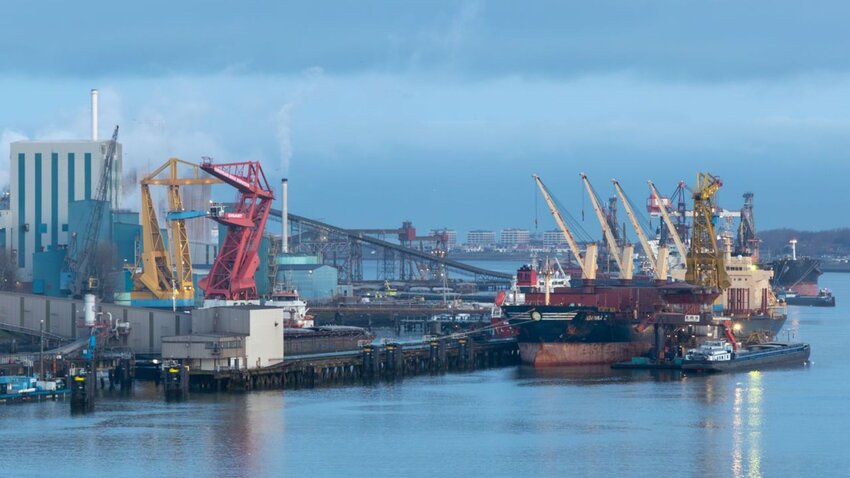
A decisive battle for the future of low-emission transport in Europe is playing out on the quays of Rotterdam and in the Antwerp petrochemical complex. Belgium and the Netherlands, historically key logistics and energy hubs for the continent, are turning into two of Europe’s leading biofuel production hubs, spurred on by EU regulatory requirements and growing demand, especially in the aviation and maritime sectors.
The current landscape
The Port of Rotterdam is now Europe’s largest biorefinery hub. The refinery operated by the Finnish group Neste on the Tweede Maasvlakte has produced renewable diesel (HVO100) since 2011 and currently has a capacity of 1.4 million tonnes per year of renewable products, the highest in Europe. Since 2025, the plant has also been capable of producing up to 500,000 tonnes per year of sustainable aviation fuel (SAF), a key part of the plan to decarbonise European air transport.
Alongside Neste, other operators are building or planning new plants in the same port area: VARO is developing a 245,000-metric-tonne-per-year SAF plant at the Gunvor refinery site in Europoort, with an estimated investment of $600 million and a planned opening in late 2026, while in February 2026, SkyNRG officially commenced construction of the first Dutch SAF plant at the Delfzijl chemical hub, with a capacity of 100,000 tonnes of SAF per year and operations expected to commence in mid-2028.
On the Belgian side, the focus is on the TotalEnergies refinery in Antwerp, which has produced SAF via co-processing since August 2025, initially at a rate of 50,000 tonnes per year, with the aim of increasing this to 80,000 tonnes.
Future prospects
The European regulatory framework continues to be the main driver of the sector. The ReFuelEU Aviation Regulation mandates that, by 2030, at least 6% of the aviation fuel supplied at EU airports must be sustainable, a figure that is set to rise to 20% by 2035 and 70% by 2050. At the same time, the European Renewable Energy Directive (RED II, subsequently updated by RED III) sets a target for Member States to increase the share of renewable energy in transport to 14% by 2030.
To meet these requirements, Belgium has adopted a more restrictive approach than the European average: the National Energy and Climate Plan aimed to meet up to 7% of the renewable energy target in transport with first-generation biofuels – the maximum limit permitted under EU legislation – but a subsequent law, in force since January 2024, has initiated a gradual reduction in the share of biofuels derived from food crops such as soy, wheat and maize, down to 2.5% by 2030. This decision reflects the growing concerns of environmentalists and institutions regarding the actual impact of biofuels derived from dedicated crops: a study by the European Federation for Transport and Environment AISBL has estimated that, over ten years, European biofuels have caused the loss of a forest area equivalent to that of the Netherlands.
The sector’s growth, in fact, is increasingly shifting towards advanced biofuels derived from waste and residues, less controversial in terms of land use than those from dedicated crops but also more exposed to the risk of import fraud: from January 2026, the EU has made more stringent audits in accordance with the ISCC PLUS standard mandatory for all shipments of lipid waste from outside the EU.
The large Dutch plants currently under construction or already operational follow precisely this approach: both the Neste refinery in Rotterdam and the new projects by VARO and SkyNRG state that they work primarily with waste raw materials such as used cooking oil and animal fats, rather than virgin vegetable oils.
- You may also be interested in: Bioenergy and industrial ecosystems: models and research projects in Europe
A start-up further upstream in the supply chain: RegenRate
While large-scale plants determine the sector’s production capacity, the real challenge lies further up the supply chain: raw materials, the current bottleneck for SAF.
This is where RegenRate comes in. Founded in 2023, this Dutch start-up has developed a model that aims to transform cover crops from a cost into a source of income for farmers. The approach is based on camelina, a non-food oilseed crop sown between main harvests, when the fields would otherwise lie fallow. RegenRate provides farmers with seeds free of charge, supports them throughout the growing process and certifies the harvested oil using a traceability system based on satellite data, prior to delivering it to producers of sustainable aviation fuel. The first pilot trials, launched in 2024, took place in the Netherlands, Belgium, Spain and Portugal; during 2025, the project was extended to France, Croatia and Hungary, reaching pre-commercial scale across seven European countries.
During the 2025 season, the company worked with around 65 farms covering 1,200 hectares of cultivated land, with the aim of exceeding 300 partner farms by 2026. In August 2025, RegenRate received an investment from the VP Capital fund, which operates in Belgium and the Netherlands.
<<There is a feedstock gap that is being anticipated by all major consulting bureaus,>> says co-founder and CEO Alice Henry, emphasising that the real constraint today is not demand but the availability of certified raw materials. According to Henry, <<sustainable aviation fuel can subsidise regenerative agriculture>> because <<it moves the cover crop from a cost towards revenue making,>> placing farmers in a financially secure position, which would encourage their curiosity and willingness to experiment with more sustainable practices.
The sustainability concern
Indeed, in an analysis focusing on EU support for sustainable biofuels, the European Court of Auditors pointed out the lack of reliable EU sources on the production of advanced biofuels. In the same report, the European Commission acknowledges that higher costs and a lack of technological and commercial maturity limit their potential compared with biofuels from dedicated crops.
- You may also be interested in: The forest as infrastructure: Canada’s bioeconomy of the future
To date, the sector is divided between those who regard it as an indispensable tool for decarbonising aviation and heavy goods transport (sectors that are difficult to electrify) and those, such as environmental organisations, who fear that the expansion of biofuels, if not strictly limited to waste-based feedstocks, will ultimately prolong dependence on fossil fuels and shift pressure onto land and forests elsewhere in the world.
Article written by Koen van Seijen
This blog is a joint project by Ecomondo and Renewable Matter
Credits
Photo by Igor Passchier

PUBLICATION
28/07/2026
Other related news

06/07/2023
5 European Start-ups non to be missed

03/04/2025
5 under 30 who have revolutionized the circular economy

23/04/2025
7 young leaders under 30 in the green and circular economy
05/12/2024
7 trends in the Green Economy that will define 2025

15/12/2024
30/05/2023

17/12/2025
Africa, a frontier for the next Green Economy
29/04/2025
Precision agriculture: what advantages does it offer and how can it support North African countries?

10/05/2024

26/11/2025
Companies: how to communicate the transition in the greenlash era?

24/04/2025
Sodium batteries: the technology that could make the EU less dependent on critical materials

29/01/2026
Wellbeing and happiness: when science meets business, society and nature

23/06/2026
Bioeconomy in North Africa: Between Resource Abundance and Structural Constraints in Tunisia, Morocco, and Egypt
07/04/2026
Bioenergy and industrial ecosystems: models and research projects in Europe