
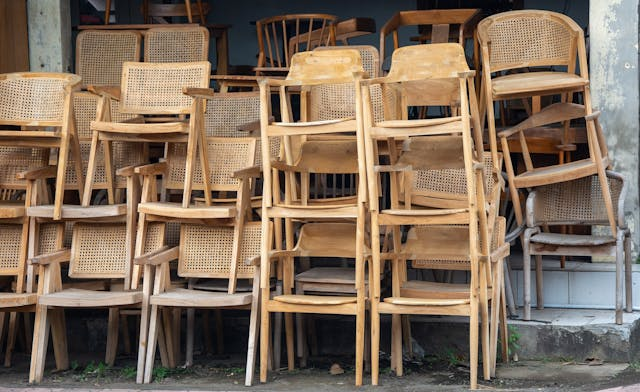
In the European Union, discarded furniture accounts for over 4% of municipal solid waste, equivalent to over 10 million tonnes per year: of this, almost all (between 80% and 90%) is incinerated or sent to landfill, while only around 10% is recycled. Where reuse occurs, it is mainly through second-hand shops, social enterprises or charities.
The European furniture sector, employing 1 million people across some 130,000 businesses and generating a turnover of over €100 billion (source: European Furniture Industries Confederation – EFIC), is thus still a long way from making the transition to a circular economy.
Beyond choosing sustainable materials, modular design, extending product lifecycles and shifting from products to services, one of the key strategies for accelerating change is the implementation of Extended Producer Responsibility (EPR) schemes.
The European Union does not at present impose a specific obligation, unlike for other waste streams such as WEEE, batteries, tyres, waste oils and textiles, but some countries are taking voluntary action in advance, turning a potential future legal obligation into a strategic opportunity.
How does an EPR scheme work?
In accordance with the EPR principle, companies that first place furniture on the national market are also responsible for its entire life cycle, including disposal and recycling. In practice, manufacturers, importers and distributors, even online, are required to contribute to the costs of collecting, sorting and recycling their products. Those involved in the procedure must register promptly with an official waste management system, then regularly report the quantities of products handled and pay the relevant fees, which vary from country to country.
The product categories covered by the EPR scheme may also vary depending on national systems, from furniture (including outdoor furniture) to textiles (bedding, cushions, decorative fabrics) to mattresses and mattress covers.
<<A well-established EPR scheme can forge relationships across the entire value chain, from raw material suppliers to manufacturers, collectors, recyclers and consumers, who in turn can support and accelerate the transition towards a circular economy>>, emphasises EFIC, which brings together 18 national associations and is conducting a study on harmonised EPR schemes for furniture, taking into account national initiatives in certain countries.
- You may also be interested in: Textile EPR, Europe leads the way globally: countries compared
France: a pioneer in EPR for furniture
France was the first European country to implement a comprehensive EPR scheme for the sector. Two consortia are involved: Ecomaison for household furniture waste and Valdelia for non-household furniture waste.
Founded in 2011 under the name Eco-mobilier, Ecomaison unites dozens of organisations from various sectors (furniture, bedding, DIY, gardening, toys, construction), involving 630 social and solidarity economy operators in the reuse of items and offering citizens around 12,000 collection points across the country. At present, 97% of the products managed by Ecomaison are recovered through reuse, recycling or energy recovery.
Similarly, Valdelia is a non-profit consortium created by manufacturers to facilitate the circular economy of professional furniture, originating from hospitals, offices and hotels.
Towards an Italian framework for EPR in the furniture sector
Italy, despite still being at an early stage, is also setting up an EPR scheme that could become a major reference point in Europe. To this end, the National Furniture System Consortium (CNSA) was established in September 2024, an initiative conceived and promoted by FederlegnoArredo, in collaboration with around thirty companies in the sector. In spring 2025, the Consortium, in agreement with the Ministry of the Environment and Energy Security, kicked off a mapping phase to bring order to a highly heterogeneous collection system, in which furniture, according to geographical area, is managed alongside other waste streams. In addition, end-of-life furniture has other specific characteristics to consider, such as multi-materiality, which complicates the separation of different components, and the long product lifecycle, making it difficult to track items and determine their value.
In order to financially support the future EPR scheme, an environmental contribution will be introduced. This will be included in the retail price of the furniture and will be proportional to the size and type of product. Those who produce more sustainable and circular furniture will pay a lower contribution.
Meanwhile, several member companies are strengthening their repair services, setting up collection points at their warehouses and retail outlets, and introducing furniture rental options – a service that could be of interest to offices, accommodation facilities of various sizes and cruise ships.
- You may also be interested in: Digital Product Passport: how digital product identity works
How other EU countries are responding
Other EU countries are also gearing up for the EPR scheme for wood and furniture. For example, in Spain, in April 2026, three major companies – El Corte Inglés, Finsa and Ikea – established a consortium to manage furniture, mattresses and bulky items.
The aim is to promote the creation of an efficient, traceable and transparent Collective Extended Producer Responsibility Scheme (Sistema Colectivo de Responsabilidad Ampliada del Productor, SCRAP), in advance of the implementation of the regulatory framework set out in Law 7/2022 of 8 April. In the coming months, the association will define the legal, financial and operational model of the future SCRAP scheme, in conjunction with other companies interested in joining.
Portugal is also working on its own EPR scheme (Responsabilidade Alargada do Produtor), in line with the targets set by the Portuguese Environment Agency (APA): by 31 December 2026, at least 25% of furniture and mattress waste put on the market must be collected, rising to 40% by 31 December 2030. By this same date, the recycling rate for collected furniture and mattresses must reach 90%.
Hungary introduced the principle of extended producer responsibility in July 2023, also including wooden furniture in the scheme. The system is managed by MoHu, the waste management company of MOL, one of Hungary’s leading oil and gas companies.
Belgium, on the other hand, has established an extended producer responsibility scheme for mattresses, specifically in three regions (Flanders, Wallonia and Brussels-Capital). To this end, the industry has set up and funded a dedicated association, Valumat ASBL, whose mission is to arrange for the efficient and cost-effective collection of used products, guaranteeing their sustainable disposal.
Article written by Maria Carla Rota
This blog is a joint project by Ecomondo and Renewable Matter
Credits
Photo by Mermoz Lionel
PUBLICATION
29/04/2026
Other related news

08/09/2022

21/03/2024
Come on, it's just a cigarette stub
24/07/2023
WEEE: a mine of critical raw materials
20/09/2023

30/05/2023

03/04/2025
5 under 30 who have revolutionized the circular economy

21/04/2023

19/05/2023
Ecomondo Mexico and the circular economy in Latin America

31/07/2023
Circular economy in China – past, present, future
14/05/2023

06/11/2023

20/10/2023

07/06/2023
Tides are changing

03/08/2023
10/10/2023

13/05/2023
A new EU industrial plan for the net-zero age