
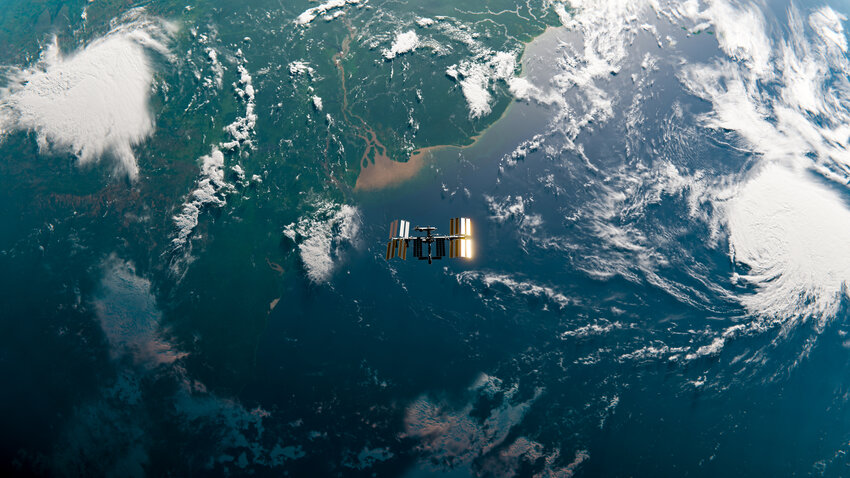
Space is the largest and most advanced testing ground available to humankind: an extreme environment where revolutionary solutions are born and which, once brought back to our planet, can help solve very real problems. This is the case in medicine, for example: in orbit, the ageing process is accelerated, and studying it allows us to improve our understanding, treatment and prevention of various diseases. Similarly, learning how to farm crops in space, where water and resources are super scarce, can give us valuable insights into how to deal with drought and desertification in farming.
Even the circular economy can benefit greatly from space research: during missions, waste production must be minimised, and every object must be designed in a sustainable fashion: it must be multifunctional, durable, reusable, easily repairable, and recyclable. Such an approach challenges traditional production models and suggests new trajectories for terrestrial industrial systems as well.
Well aware of it is Marcello Azzoni, founder and Chief Research and Development Officer of Spacewear, an Italian space clothing start-up, as well as a member of the Technical Scientific Committee of BEX – Beyond Exploration, the new expo-conference dedicated to the space economy and commercial space flight, scheduled for 23 to 25 September 2026 at the Rimini Exhibition Centre, promoted by Italian Exhibition Group (IEG) in collaboration with the Emilia Romagna Region. <<We are a brand born in space, now preparing to export our highly integrated technological know-how to Earth,>> explains Azzoni.
Spacewear, Made in Italy brought to space
The start-up he established has developed the Smart Flight Suit 2 (SFS2), a new generation interactive suit developed for the safety and well-being of astronauts. An evolution of the SFS1, tested in 2023 during the Italian Air Force's Virtute 1 mission, the SFS2 is manufactured with innovative lightweight, breathable, fire-resistant and thermoregulating materials and incorporates a high-precision biomedical monitoring system. Following successful review by NASA and the International Space Station, the SFS2 was the only Italian experimental suit tested on board the ISS during Axiom Space's Ax-3 mission, worn by astronaut Walter Villadei. This achievement opens up new prospects for technology transfer from the space sector to terrestrial applications, with benefits in terms of innovation, design and sustainability. The next goal for Spacewear is to bring these principles to Earth: <<With Virgin Galactic, we are gearing up to launch a clothing line for space tourism, opening the door to the fashion of the future and revolutionising its aesthetics and functionality,>> explains Azzoni.
The new space economy and the paradigm shift
Designing for space means a paradigm shift: <<Washing clothes on an orbiting station is complex and therefore requires radically different solutions. That is why we have developed special fabrics which, thanks to advanced treatments, can be reused up to 40–60 times without washing, resulting in significant savings in water and energy and a drastic reduction in pollution linked to the use of detergents. Extending the durability of garments also means less production and therefore less textile waste, which is a really big environmental problem right now.>>
In line with the three Rs of the circular economy (Reduce, Reuse, Recycle), <<One of the main rules is to avoid waste, so we could say that long life is also ecological: recycling requires energy, because you have to dismantle the products, then return the materials to their raw state and reprocess them. Space, on the other hand, teaches us to throw away less and use more, building multifunctional and durable objects that cannot break, because in orbit it is not possible to replace or repair them easily.>>
- You may also be interested in: Space to Earth (and back): Rimini hosts BEX, the first event dedicated to the new space economy
An accelerator for new models
When it comes to sustainability in space, an ever more pressing issue to consider is the disposal of end-of-life technologies and infrastructure, known as space debris: satellites, electronic components and fragments from abandoned missions that crowd Earth's orbits. Once again, the space economy is looking at modular design, reuse, recycling of materials and controlled re-entry: it is essential to extend the life cycle of all these components and think about their disposal from the outset.
In this perspective, the space economy is not only a technological frontier, but also an accelerator of new cultural and production models. <<Space will be the next human civilisation,>> concludes Azzoni. <<As has happened in the past with groundbreaking inventions that have revolutionised our way of life, such as the car, today we are witnessing the convergence of three transformative technologies and innovations: artificial intelligence, quantum computing and the space economy. A change that is set to reshape the entire spectrum of human knowledge at an exponential rate.>>
Article written by Maria Carla Rota
This blog is a joint project by Ecomondo and Renewable Matter
PUBLICATION
28/01/2026
Other related news

06/07/2023
5 European Start-ups non to be missed

03/04/2025
5 under 30 who have revolutionized the circular economy

23/04/2025
7 young leaders under 30 in the green and circular economy
05/12/2024
7 trends in the Green Economy that will define 2025

15/12/2024

30/05/2023

17/12/2025
Africa, a frontier for the next Green Economy

29/04/2025
Precision agriculture: what advantages does it offer and how can it support North African countries?

10/05/2024

26/11/2025
Companies: how to communicate the transition in the greenlash era?

24/04/2025
Sodium batteries: the technology that could make the EU less dependent on critical materials

29/01/2026
Wellbeing and happiness: when science meets business, society and nature
27/11/2024

17/09/2024
Blue Rolodex: Start-up & Influencer of the Blue Economy