
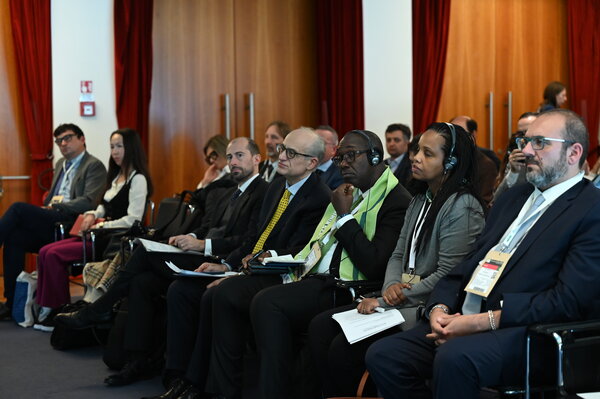
In order to tackle Africa's energy, environmental and climate challenges, while safeguarding against risks related to water and food insecurity, steps must be taken together, through dialogue and cooperation: this was the message that emerged at the fifth Africa Green Growth Forum, held at Ecomondo 2025. Italian institutions, international organisations, African governments and companies operating on the continent debated access to energy, sustainable investments and novel forms of cooperation.
A collaboration that <<can no longer be read only in terms of solidarity, but must be seen as a strategic partnership for the global energy transition,>> emphasised Fabio Fava, chairman of Ecomondo's Technical-Scientific Committee. He explained that Italy, Europe and Africa must move as equal partners, sharing technologies and know-how, to foster mutual development and growth.
The event focused primarily on the alignment between the Mattei Plan and Mission 300: the former is the plan of national interest launched by the Italian government in 2024, aiming to promote a new model of cooperation. It is based on mutual development, shared prosperity and joint action for climate resilience, with the involvement of different sectors, from energy to education, from agriculture to water, from health to infrastructure. The latter is a multilateral programme promoted by the World Bank and African Development Bank, targeting the goal of bringing electricity to 300 million people in sub-Saharan Africa by 2030.
Italy’s role with the Mattei Plan
<<Italy has joined Mission 300 from the very beginning, playing an active role in defining the various national roadmaps for electrification. The government has already approved €200 million through the Italian Climate Fund, and is finalising interventions for a further 500 million or so in the coming months,>> explained Councilor Fabio Massimo Ballerini, Director of the Piano Mattei Task Force - Presidency of the Council of Ministers. <<Priority interventions cover Mozambique, South Africa, and soon Côte d'Ivoire, while new opportunities are opening up in the framework of the Global Gateway,>> the EU strategy aimed at promoting smart, clean, and secure connections in the digital, energy, and transport sectors, and at strengthening health, education, and research systems worldwide.
The Mattei Plan is a tool currently transforming the patterns of the Italian presence in Africa. <<The public-private partnership is an important concept in these times of hybrid democracy, where the different actors each represent the indispensable link in a chain,>> continued Fabrizio Lobasso, Minister Plenipotentiary, Directorate General for the Promotion of the Country System – Ministry of Foreign Affairs and International Cooperation. <<From this perspective, system missions are an effective tool: they do not necessarily have to be political, but can also be technical-institutional, in order to offer greater flexibility in terms of agenda and organisation. The value of interculturalism, that is, the ability to see reality through the eyes of the other, is fundamental, while the stereotype that would like Italy to be limited to traditional sectors must be overcome: today our country is engaged in innovative fields, such as renewables, agri-tech, digitalisation and green supply chains.>>
Italy, through the MASE (Ministry of the Environment and Energy Security), is also supporting other international projects, such as the Energy Sector Management Assistance Programme (ESMAP), a global programme of the World Bank to help low- and middle-income countries develop sustainable energy solutions, and the 3DEN initiative, in collaboration with the International Energy Agency (IEA) and the United Nations Environment Programme (UNEP), which promotes the dissemination of digital technologies to optimise energy production, distribution and consumption.
Mission 300: electricity is a right
Going into the details of Mission 300 was Robin Hendrix (World Bank Group), who recalled how <<600 million people in Africa still have homes without electricity, literally in the dark, and without the energy they need to cool their medicines or run their businesses. It is not a luxury, it is a matter of dignity.>>
Since the launch of the programme, 50% of the target population has received access to electricity. <<Mission 300 is not a subsidy, but a fair, reliable and equal partnership, which mobilises public and private for resilient growth. On one side, we need public finance to lower the risk; on the other, we need private finance to scale up. This is where Italy comes in with the Mattei Plan.>>
As Davinah Milenge Uwella (African Development Bank) recalled, <<Africa has 70% of the global solar potential, and energy is now an essential lever to foster industrial development, youth employment, innovation, and the reduction of forced migration.>> Improved access to energy for these communities means clean water and sanitation, but also stimulating rural development through agricultural mechanisation, value-added processing and the growth of a sustainable local supply chain.
Cote D'Ivoire: a fast-growing country
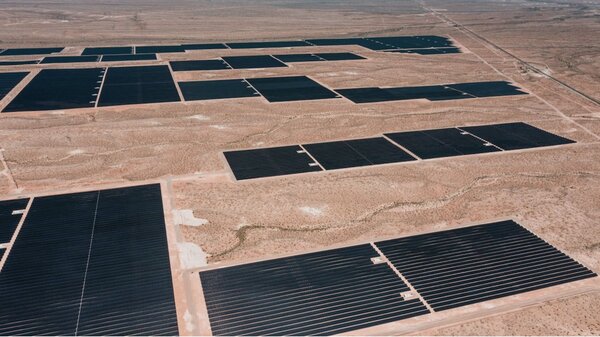
A focus on Côte d'Ivoire, West Africa's leading economy on account of its mineral and oil resources, was proposed by Gustave Aboua, the country's Minister for the Environment and Sustainable Development. He aims to reduce emissions by 30% by 2040 and to build 10 solar power plants (9 onshore and 1 offshore): <<We have developed special committees and regulations to ensure that investments are not risky, but are guaranteed by an institutional framework. We want to offer companies total legal and operational security.>>
Partnerships and investments: tools and opportunities
Several Italian and European economic-financial players are committed to Africa, including Confindustria Assafrica, RES4Africa, CDP, SACE and Simest, as well as SMEs that are now approaching the continent, alongside the large groups already present. In this Europe-Africa cooperation framework, the European Investment Bank (EIB) is increasingly shaping up as the European Union's climate bank, with a remit that combines energy transition, industrial competitiveness and the resilience of the communities most exposed to climate impacts.
<<In 2024, the EIB invested €8.4 billion outside the EU, including around €2 billion in sub-Saharan Africa, mainly in green finance and clean energy,>> Roberto Rando pointed out. <<Under the Global Gateway, the EIB is combining loans, warranties and investment grants, handling around 70% of European budget guarantees to reduce the risk of capital.>> Examples cited include a project in Mauritania to build 600 km of high-voltage transmission lines and the DESIREE programme, which in Madagascar supports the electrification of homes, SMEs, schools and hospitals through solar mini-grids. “For the energy transition is not only about energy production, but also about networks, access and inclusion.>>
Article writte by Maria Carla Rota
This blog is an editorial project by Ecomondo and Materia Rinnovabile
PUBLICATION
22/12/2025
Other related news
08/09/2022
21/03/2024
Come on, it's just a cigarette stub
24/07/2023
WEEE: a mine of critical raw materials
20/09/2023
30/05/2023
03/04/2025
5 under 30 who have revolutionized the circular economy
21/04/2023
19/05/2023
Ecomondo Mexico and the circular economy in Latin America
31/07/2023
Circular economy in China – past, present, future
14/05/2023
06/11/2023
20/10/2023
07/06/2023
Tides are changing
03/08/2023
10/10/2023
13/05/2023
A new EU industrial plan for the net-zero age