
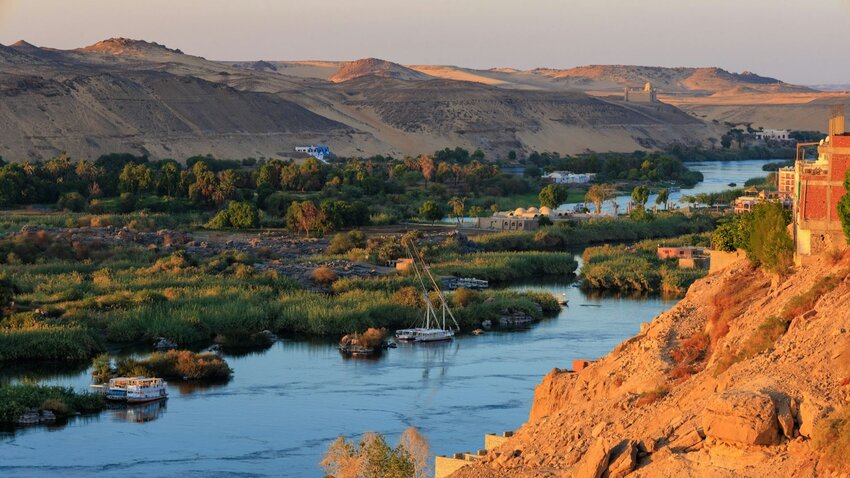
Before sunrise in Egypt’s Nile Delta, farmers check irrigation canals before entering their fields. For many, the first question of the day is no longer how much they will harvest, but whether enough water will reach their land. Egypt’s water challenge goes beyond scarcity, shaped by population growth, climate change and shifting Nile Basin politics. With nearly 120 million people relying on the Nile for most of its renewable surface freshwater, the river remains at the centre of a struggle over resources, resilience and regional cooperation.
A River Facing Multiple Pressures
Egypt has gradually moved from relative water abundance to chronic scarcity. Per capita water availability has declined sharply over the past decades, falling from around 2,000 cubic metres per person in the 1960s to roughly 500 today, placing the country well below the international water scarcity threshold. With water demand exceeding available freshwater resources, Egypt increasingly relies on agricultural drainage reuse, treated wastewater, groundwater extraction and desalination to bridge the gap.
In a country where more than 95% of the land is desert, life has long been concentrated along the Nile Valley and Delta, which cover less than 4% of Egypt’s territory and support most agricultural activities.
For communities along the Nile and the Delta, the water challenge is not only about availability but also quality. Farmers and households increasingly face concerns linked to pollution, agricultural drainage and wastewater management, making water security a daily reality.
Dr. Nader Nour El-Din, Professor of Water Resources and Land at Cairo University’s Faculty of Agriculture, argues that Egypt’s water challenge stems from the widening gap between available resources and rising demand, intensified by population growth, climate change and Nile Basin developments. He highlights the growing role of non-conventional water resources, particularly water reuse, while emphasising that water security is closely linked to food security through concepts such as “virtual water” trade and more efficient agricultural practices.
- You may also be interested in: Mediterranean Day, Elisa Conti (CNR): <<The sea does not begin at the coast: we need a source-to-sea approach>>
The Nile’s Political Battle
Among the main external pressures shaping Egypt’s water future is the Grand Ethiopian Renaissance Dam (GERD). While Egypt sees the dam mainly through the lens of downstream water security, Ethiopia views it as a key project for development and energy generation. The dispute reflects a wider challenge in transboundary water management: balancing national development ambitions with the need for cooperation over shared resources. More than a decade of negotiations has yet to produce a binding agreement on dam operation, drought management and water sharing, despite mediation efforts by the African Union and the United States.
Creating New Pathways for Water Security
Facing growing pressure on Nile supplies, Egypt has expanded investments in wastewater reuse, desalination and other non-conventional water resources.
The New Delta project includes the Al-Hammam wastewater treatment plant, designed to process around 7.5 million cubic metres of agricultural drainage water per day and support agricultural expansion in the New Delta region.
Another major initiative is the Bahr El-Baqar wastewater treatment plant, recognised by Guinness World Records as one of the world’s largest wastewater treatment facilities, with a capacity of around 5.6 million cubic metres per day. The treated water from Bahr El-Baqar is used to support agricultural development, particularly in the Sinai Peninsula.
Desalination has become another pillar of Egypt’s water strategy, with plans to expand capacity along the Mediterranean and Red Sea coasts. While it cannot replace Nile water for agriculture due to its high cost, it can support coastal communities, tourism and industry.
Egypt is also investing in climate adaptation, coastal protection and digital tools to improve how water is monitored and managed.
The Road Ahead for Egypt’s Water Future
Egypt's long-term strategy increasingly treats water security as both a development priority and a strategic necessity. Its future will depend on balancing infrastructure investment with better governance, agricultural reform and climate adaptation. The coming decades will test whether Egypt, Ethiopia and Sudan can establish a sustainable framework for Nile cooperation, whether desalination can remain economically viable, and whether water reuse can keep pace with population growth.
- You may also be interested in: Turkey’s water infrastructure: rising demand and climate pressures
Egypt has always been described as the gift of the Nile. The question facing the country today is how to secure that gift for future generations in a world where water is becoming increasingly uncertain.
Article written by Rim Ben Khalifa
References
Food and Agriculture Organization of the United Nations – AQUASTAT – Data on Egypt’s water resources, agriculture and water scarcity.
World Bank – Water Data and Egypt Water Sector Reports – Analysis of water security, climate adaptation and development challenges.
Egyptian Ministry of Water Resources and Irrigation (MWRI) – Information on Egypt’s water strategy, water reuse, desalination and infrastructure projects.
African Union (AU) – Reports and statements on Nile Basin cooperation and transboundary water governance.
Atlantic Council – Analysis of the Grand Ethiopian Renaissance Dam (GERD) and Nile Basin geopolitics.
Guinness World Records – Verification of Egypt’s large-scale wastewater treatment facilities.
Fanack Water and Smart Water Magazine – Technical background and updates on Egypt’s water management initiatives.
Scientific studies on Nile Delta water quality and pollution – Research on agricultural drainage, wastewater and environmental pressures.
This blog is a joint project by Ecomondo and Renewable Matter
Credits
Photo by Martijn Vonk
PUBBLICAZIONE
28/07/2026
Altre news correlate

06/07/2023
5 Start-up circolari da non perdere
03/04/2025
5 under 30 che hanno rivoluzionato l'economia circolare

23/04/2025
7 giovani under 30, leader della green and circular economy
05/12/2024
7 trend nell'economia green che definiranno il 2025

15/12/2024
AI, big data e tecnologie predittive per la Blue Economy
30/05/2023
Acqua in Europa: come affrontare il cambiamento climatico

17/12/2025
Africa, frontiera della prossima economia verde
29/04/2025
Agricoltura di precisione: quali vantaggi offre e come può sostenere i paesi del Nordafrica?
10/05/2024
Alluvione in Emilia-Romagna, un anno dopo

26/11/2025
Aziende: come comunicare la transizione nell’era del greenlash?
24/04/2025
Batterie al sodio: la tecnologia che può rendere l'UE più indipendente dai materiali critici

29/01/2026
Benessere e felicità: quando la scienza incontra impresa, società e natura

23/06/2026
Bioeconomy in North Africa: Between Resource Abundance and Structural Constraints in Tunisia, Morocco, and Egypt
07/04/2026
Bioenergy and industrial ecosystems: models and research projects in Europe