
Spain has the companies, technology and industrial capacity to recover materials, yet only 8.5% of the materials it consumes are fed back into the production cycle, compared with around 11.8% in the EU in 2023. Despite receiving significant European funding to accelerate the transition, the country remains heavily dependent on virgin raw materials. The challenge is no longer simply to recycle more, but to turn waste into a competitive industrial resource.
The technology, however, is no longer the main obstacle. Sonia Albein, circular economy and environment officer at AIMPLAS – Plastics Technology Center, sees Spain entering a new phase: <<We are entering a phase of industrial acceleration in the circular economy. The technology, investment and businesses are already there. What we need now is stronger infrastructure, more integrated value chains and markets for secondary raw materials.>>

- You may also be interested in: Circular factories in Europe: the automotive industry is redesigning the life cycle of vehicles
€492 million allocated by the Spanish government
To close that gap, the Spanish government allocated €492 million to projects designed to make production more circular, with plastics, textiles and renewable-energy equipment among the priority sectors. The programme is expected to mobilise more than €1.2 billion in total investment.
The next test is whether those investments can be scaled into viable businesses: securing a reliable supply of waste, consistent quality in secondary raw materials, stable demand and a viable business case. <<Public investment is very important to reduce the initial technological risk, but we need that innovation to generate value chains that can compete and survive in the market,>> Albein says.
Spain starts from a relatively strong industrial base. The textile, fashion and footwear sector alone accounted for 2.7% of Spanish GDP in 2022, and the country retains an industrial chain covering everything from fibre preparation and spinning to weaving, dyeing and garment manufacturing. New businesses are emerging around recycling, reuse, eco-design and advanced sorting.
Industrial capacity alone is not enough to make recycled materials competitive with virgin ones. <<Sometimes, a recycled compound can cost more than virgin material,>> says Ethel Eljarrat, Director of the Spanish Institute of Environmental Assessment and Water Research (IDAEA). For Spanish industry, the opportunity lies in replacing part of the virgin materials used in manufacturing with recycled ones — if they can be supplied at the right quality and price.
- You may also be interested in: Bioenergy in Poland: agriculture as the driving force of the energy transition
The challenge of circularity, from plastics to textile
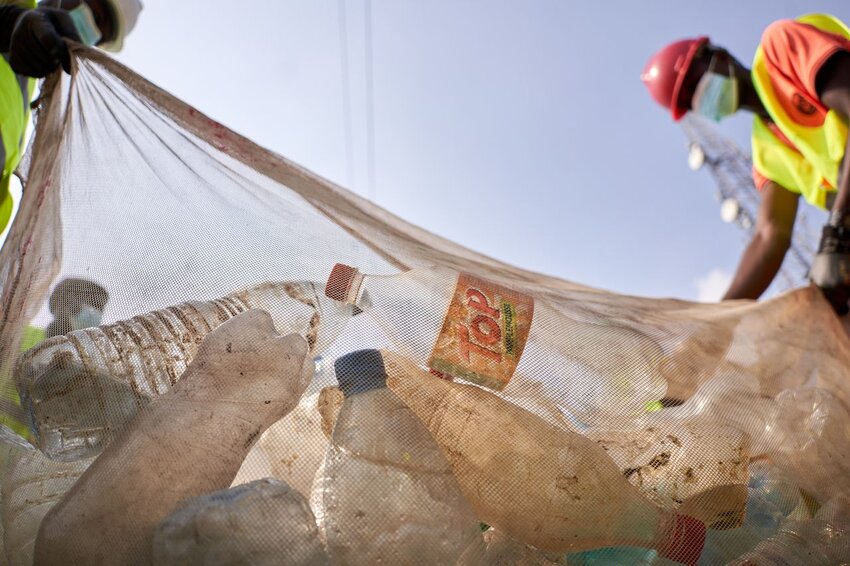
There is a problem even before recycled material reaches the market: getting enough suitable waste into the system in the first place. Spain needs better collection systems and technologies capable of making better use of the waste that reaches sorting facilities. Its deposit-return systems also lag behind those of other European countries. <<In several European countries, water bottles are already collected through dedicated machines. This type of selective collection makes it much easier to recycle them,>> Eljarrat points out.
Plastics are perhaps the clearest test of whether this transition can become an industry. Spain recycled 46.2% of its plastic packaging waste in 2023, above the EU average of 42.1%. Spain has identified the sector as strategic in its public investment programme to accelerate the circular economy. Plastics are used across industries ranging from food and automotive to construction, agriculture, healthcare, electronics and renewable energy. Making the material more circular could therefore have an impact across multiple value chains. Recycling, however, is only part of the equation. The bigger challenge is getting those materials back into production.
If plastics illustrate the economic challenge of circularity, textiles expose a different problem: the difficulty of recovering materials at a quality high enough to use again. Spain generates around 900,000 tonnes of textile waste a year, yet only around 12% is collected separately for reuse or recycling. Many garments are made from blends of cotton, polyester, elastane and polyamide, making the fibres difficult to separate and limiting the ability to produce high-quality recycled materials. “A lot of work remains to be done in textile recycling,” Eljarrat says.
Competitive, supported by stable demand and safe to use
A more difficult question is what happens to the substances already present in the material. Recycling can carry substances from a material’s previous life into the new product. <<When you have a residue from a material that has been used, those toxic compounds can still be present. When you recycle it, the resulting material may still contain them,>> Eljarrat warns.
Increasing recycling rates, therefore, cannot be the sole objective. <<The circular economy must be clean, because we need to make sure that recycling waste does not lead to greater health problems,>> Eljarrat concludes.
The next step for Spain is to turn recycled materials into a reliable source of industrial inputs. They need to be competitive with virgin materials, supported by stable demand and safe to use. Only then can waste become an industrial resource rather than simply a management problem.
Article written by Ana López García
This blog is a joint project by Ecomondo and Renewable Matter
Credits
Photo by Xavier Messina
PUBBLICAZIONE
25/09/2026
Altre news correlate

06/07/2023
5 Start-up circolari da non perdere
03/04/2025
5 under 30 che hanno rivoluzionato l'economia circolare

23/04/2025
7 giovani under 30, leader della green and circular economy
05/12/2024
7 trend nell'economia green che definiranno il 2025

15/12/2024
AI, big data e tecnologie predittive per la Blue Economy
30/05/2023
Acqua in Europa: come affrontare il cambiamento climatico

17/12/2025
Africa, frontiera della prossima economia verde
29/04/2025
Agricoltura di precisione: quali vantaggi offre e come può sostenere i paesi del Nordafrica?

10/05/2024
Alluvione in Emilia-Romagna, un anno dopo

26/11/2025
Aziende: come comunicare la transizione nell’era del greenlash?
24/04/2025
Batterie al sodio: la tecnologia che può rendere l'UE più indipendente dai materiali critici

29/01/2026
Benessere e felicità: quando la scienza incontra impresa, società e natura

23/06/2026
Bioeconomy in North Africa: Between Resource Abundance and Structural Constraints in Tunisia, Morocco, and Egypt
07/04/2026
Bioenergy and industrial ecosystems: models and research projects in Europe