
An elderly man, wearing a flat cap and slippers, sits on a chair tilted back against a wall. In this precarious yet somehow stable position, he gazes out at a village that, like him, seems suspended between past and present, old and new, nostalgia and hope for the future. This photograph, chosen for the new edition of Terracarne (Strade Blu, Mondadori), encapsulates the thinking of poet and paesologist Franco Arminio. We met him at “An Ecomondo of Poetry”, an event included in the Ecomondo Off program and organised by the cultural magazine Sapereambiente, directed by Marco Fratoddi.
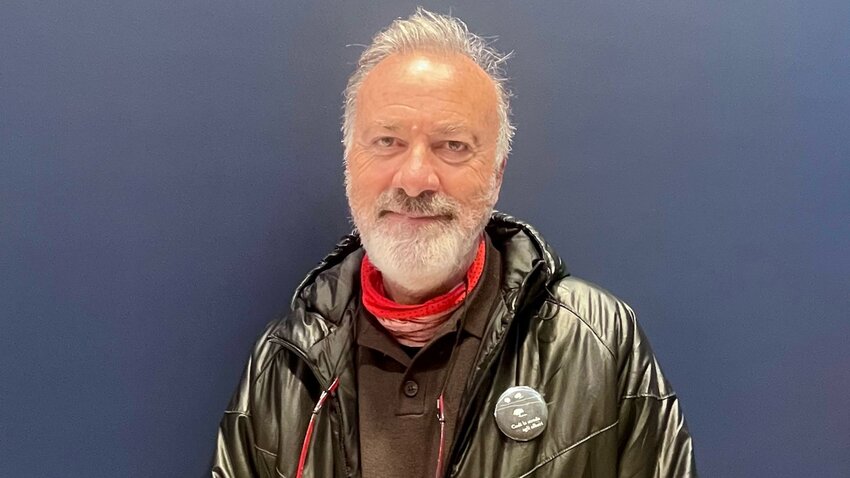
First published in 2011, Terracarne is back in bookshops. What’s new in this edition?
This edition features a foreword by Serenella Iovino, an expert in literature and the environment who teaches in the United States (she is James G. Hanes Distinguished Professor in Humanities at the University of North Carolina, Chapel Hill, editor’s note).
The book also includes new texts that explain paesology in more depth, along with a list of thirty proposals for tackling the depopulation of small villages. It also has a section with thirty-two photographs I took myself. I have, however, removed some texts that no longer seemed appropriate. Places, after all, are like people: sometimes you understand them right away; at other times, you think you have understood them, only to see them differently later on.
How have villages changed over the past fifteen years?
Depopulation has not stopped; it has continued. In the past, you could arrive in a village and find poverty, perhaps, but it was alive and full of people. Today, people may be a little better off and the houses are well maintained, but there is a kind of desolation that simply wasn't there before. A sort of void effect: some people have left, others have passed away, and some have moved to the suburbs. It’s as if the villages have a hole right in the middle. And so, inevitably, there’s this rather sombre atmosphere.
Are there any stories of villages that have managed to turn things around?
Unfortunately, I can't think of any. Take Aliano, for example, where I organise the La luna e i calanchi festival. It's a welcome breath of fresh air, including in economic terms, but depopulation continues all the same. That gives you some idea of just how complex and difficult the problem is. After all, Italy may be a country of villages and mountains, but its policies are focused on cities, as though Rome and Milan were all that existed.
There is a kind of geographical short-sightedness that prevents us from seeing the real country: a wrinkled country, demographically as well, inhabited largely by older people.
So there is no hope?
Actually, I believe that the heritage of the Italian villages is so important that not only will they not disappear, but – at some point in the future, though I cannot say exactly when – they will make a comeback.
We come from a culture in which big was considered beautiful, right and important, while small was seen as something with less value. We looked to the big factory, FIAT, the big city. Now we are beginning to realise that the big cannot grow indefinitely, and we are coming to understand once more that the small can also have its merits.
In small towns, relationships are less commercialised and there is a different quality of life, with neighbours bringing you figs from their garden. The small is not the opposite of the big: it is different; it is something else entirely. We need a kind of new humanism rooted in the mountains and villages, one that teaches children from an early age that staying in a village does not mean living in an unfortunate place.
What does the paesological gaze reveal to us?
Paesology is different from sociology or journalism. It is not a specialised way of looking at things: it takes in the whole place, not just its human element. A village is made up of faces and houses, but also trees, grass snakes and butterflies. My approach to the environment is holistic: I look at a village in all its human and natural geography. The paesologist's gaze discards nothing, just to mention a circular principle.
And when you look at cities in this way, what do you see?
Cities are highly complex and important places, and I wouldn't claim to be an expert. When I visit a village, I can more or less understand its dynamics, including the economic and historical ones, because I've seen so many of them.
In a village, for a start, you see things one at a time; in the city, there’s always the same space in which too many things are crammed together: cars, buildings, people. We need to try to thin them out a little, not least in the face of climate change. As temperatures rise in an already overcrowded space, living conditions deteriorate. Quite literally, you have to endure other people's sweat.
Should we redistribute the Italian population across the country?
We should. If just 5% of the population of any Italian city were to move back to the villages, it wouldn't cause any great upheaval. Someone living in Parma, for example, could move to the Parma Apennines. Naturally, the basic services would have to be provided: schools, transport and healthcare.
Cities would benefit too: with fewer people, their services would no longer be so overstretched. It takes time to achieve all this, and politicians aren’t getting involved, because they focus on the here and now.
In the book, you put forward thirty proposals to combat depopulation.
Some are more visionary, others more practical. They’re meant to get people thinking. Even if just one were taken up, that would already be something.
One key priority is to invest in young people, both to encourage those who are still there to stay and to bring back those who have left. We should also bring to these villages what I call “coaches”: people with no ties to the place who can inject fresh energy into communities that have lost their vigour. Because building new facilities is not enough; you also need to find those willing to look after them.
How important is it to support policies tailored to individual places?
What works in Liguria won't necessarily work in Calabria; what works in a village near a city won't work in one a thousand metres above sea level. Likewise, a village of 300 inhabitants is not the same as one with 5,000.
No two villages are alike. Indeed, we should protect their differences and keep them alive. If a village has a traditional dance, biscuit or costume found nowhere else, we must preserve it. These differences are a source of richness.
- You may also be interested in: Ecomondo beyond the Euro-Mediterranean borders: a 14% increase in international visitors
Ecomondo puts circularity at the centre: how does this relate to the local area?
In some villages, there are still farmers who have a natural flair for recycling. However, we mustn’t assume that everything that was done in the past was necessarily better.
Scientific knowledge about how to process different materials is therefore very welcome. We need to teach smart ways to reuse and explain what can be made from materials and waste piled up on villages' farms. We need to bring together the old and the new, the wild fur and the computer. And then, villages need to be airy and open.
I say we need to move from a "puddle community" to a "stream community". The former is a community made up solely of residents, one that risks becoming a closed-off place. A village, on the other hand, is alive when there are locals, but also people coming from elsewhere.
- You may also be interested in: The green economy amid geopolitical crises and industrial challenges: eight global forces accelerating the transition
You also argue that we need to rediscover kindness. What do you mean by that?
There was a time when kindness was regarded as secondary, almost a decorative extra. Today, however, in a world full of wars, aggression and resentment – even between individuals – being kind has become almost a political project. Greeting an elderly person is not simply an act of kindness, it is a local development project.
There are countless ways in which we can make the world a kinder place: picking up a piece of litter, looking after others, watering a wilting plant. We need to become something like nurses to the planet. Because we are creatures capable of kindness. We are not predators, we are creatures of care.
Of course, we need to find food for ourselves, but we can also nourish, restore, recycle and give. Instead of replacing one pair of shoes with another, recover the one you already had. And we can “restore” landscapes.
In what sense?
Let me give you an example. Once, there was a pool of water in a particular place where frogs lived. Today, because of the climate crisis, that pool is drying up and the frogs are disappearing. How can we prevent this? We need to understand this, perhaps by altering the water course.
These are measures that require expertise, but above all a keen eye. This is where ecology begins: to care about a place, you first have to look at it.
Article written by Maria Carla Rota
This blog is a joint project by Ecomondo and Renewable Matter
PUBBLICAZIONE
13/11/2026
Altre news correlate
08/09/2022
Inquinamento da plastica in mare: cause, conseguenze e soluzioni
21/03/2024
Ma dai, è solo un mozzicone
24/07/2023
RAEE: una miniera di materie prime critiche
20/09/2023
La plastica: da problema a risorsa
30/05/2023
Acqua in Europa: come affrontare il cambiamento climatico
03/04/2025
5 under 30 che hanno rivoluzionato l'economia circolare

21/04/2023
La giornata mondiale della terra, vista dal mare
19/05/2023
Ecomondo Mexico ed economia circolare in America Latina
31/07/2023
Economia circolare in Cina. Ieri, oggi e domani
14/05/2023
Sulla strada della sostenibilità: elettrificare il trasporto merci
06/11/2023
Lifegate presenta Water Defenders Alliance, una grande alleanza per difendere le nostre acque
20/10/2023
Legno-arredo, la filiera che ha messo la sostenibilità al centro
07/06/2023
Le maree stanno cambiando
03/08/2023
La filiera del riciclo della carta: eccellenza italiana con margini di miglioramento
10/10/2023
Responsabilità estesa ed ecoinnovazione, la sfida del tessile sostenibile non può attendere
13/05/2023
Europa: arriva il nuovo piano industriale per l’era net-zero